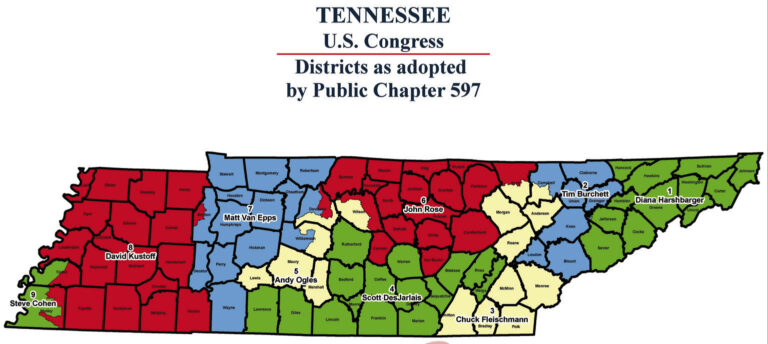
Moore County now in Memphis district

Moore and Bedford counties are going to see big changes when it comes to its representation in Washington D.C. as a Republican redistricting plan has put both counties in the same district as parts of inner-city Memphis. The redistricting was signed into law by governor Friday.
The redistricting is part of a special session where lawmakers dramatically changed the political landscape by blowing up the traditional Democratic hold on the Greater Memphis area by incorporating a vast district that runs from Memphis to Lynchburg to dilute Democratic control. Moore County and Bedford went from the 4th Congressional District where it is represented by Scott Desjarlais to the 9th District where they fall under the leadership of Steve Cohen. The shift put Moore County on the far eastern frontier in a mainly west-Tennessee district, pulling it from its middle Tennessee roots.
Meanwhile the move changed the landscape in Memphis for a district that was re-created as a result of the redistricting cycle after the 1980 census. The district is almost exclusively urban, due to its mostly cohabitant nature with Memphis. Steve Cohen has represented the Memphis-centered district since 2007.
During last week’s special session, House Speaker Cameron Sexton (R-Crossville) and Senate Majority Leader Jack Johnson (R-Franklin) filed House Bill 7003/Senate Bill 7004 to redraw Tennessee congressional districts, ensuring the state’s representation in Washington reflects its conservative values.
“Tennessee is a conservative state and our congressional delegation should reflect that,” said Sen. John Stevens (R-Huntingdon), who is carrying the Senate bill. “This bill ensures it does.”
The legislation modernizes Tennessee’s redistricting process by removing racial data from the mapmaking process entirely. It is a direct response to a renewed national conversation on redistricting. The Alexander v. South Carolina State Conference of the NAACP and Louisiana v. Callais decisions by the Supreme Court have clarifi ed the legal landscape for redistricting. Those decisions confirm the state can put its lawful, conservative policy goals at the forefront.
“The Supreme Court has opined that redistricting, like the judicial system, should be color-blind. The decision indicated states like Tennessee can redistrict based on partisan politics,” said Speaker Sexton, who is carrying the House bill. “Tennessee’s redistricting will reduce the risk of future legal challenges while promoting sound and strategic conservatism.”
While Republicans claim they are trying to get Tennessee on the same conservative page, opponents are calling it Gerrymandering.
Gerrymandering is the term for redistricting in a manner that is meant to benefi t a single group or political party. The name derives from a plan early in U.S. history, in which a district was drawn to divide the support of the Federalist Party in order to create several districts more favorable to Massachusetts Governor Elbridge Gerry’s Democratic- Republican Party.
The change will go into effect this coming election for U.S. Congress. The change also brings Lincoln and Marshall Counties into the 9th but leaves Coffee County and Franklin County in the 4th. For those interested in running for the 9th congressional seat there is little time.
Candidate nominating petitions may be obtained from the State Division of Elections or from local county election commission offices. The State Division of Elections is open Monday through Friday from 8 a.m. to 4:30 p.m. Local office hours are available through the county election commission lookup here: https://sos. tn.gov/elections/services/find -my-county-election-commission. New candidates must collect a minimum of 25 signatures from registered voters residing in a county that is part of the congressional district for which the candidate is seeking office.
The original nominating petition must be filed with the State Division of Elections, located at: 312 Rosa L. Parks Ave.,
7th Floor William R. Snodgrass Tower Nashville, TN 37243